primary Glaucoma
The Kennel Club and British Veterinary Association have added the Hungarian Vizsla to their list of breeds predisposed to Primary Glaucoma.
What is Primary Glaucoma?
Primary glaucoma is an inherited condition caused by a build-up of pressure in the eye. This increased pressure occurs because the eye is not able to properly drain away enough of the fluid made inside.
Primary glaucoma can be divided into two types:
- Primary open angle glaucoma (POAG)
- Primary angle closure/ closed angle glaucoma (PCAG).
What is primary glaucoma?
This is a condition where there is a high pressure build up inside the eye. It is very painful for the dog – and there is often loss of the eye(s)
What causes primary glaucoma ?
The most common cause of primary glaucoma in the Vizsla is Pectinate Ligament Abnormality (PLA). The condition used to be known as Goniodysgenesis. PLA is an inherited defect where the drainage angle is faulty leading to a failure of normal drainage of fluid
Can PLA be detected ?
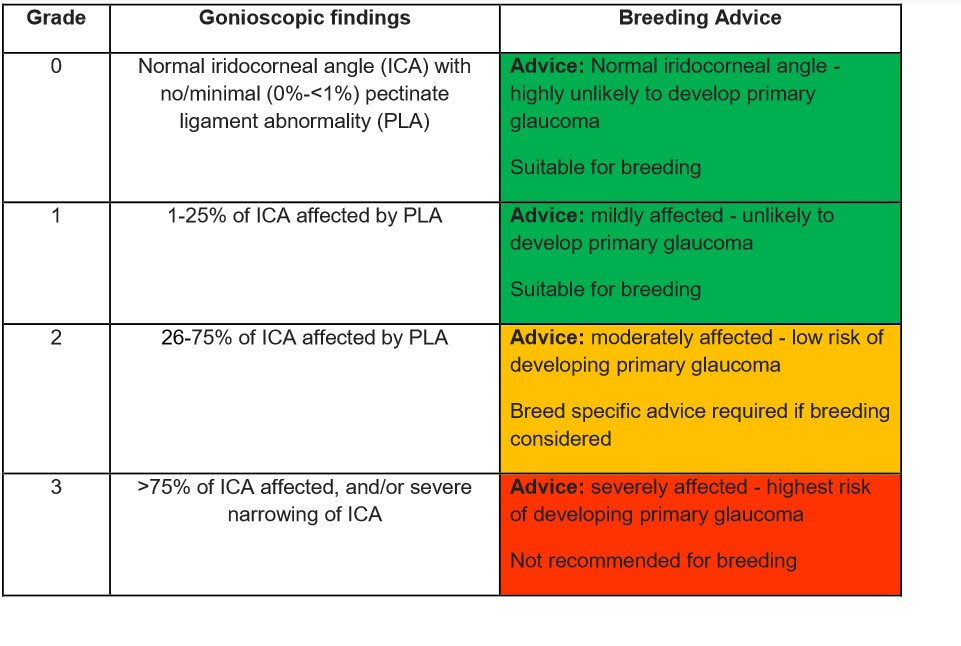
Yes – the condition is detected by Gonioscopy – an examination of the drainage angle with a special lens (goniolens) Gonioscopy is a procedure separate from routine eye examination. The risk of an individual developing primary glaucoma can be predicted by the degree of abnormality of the drainage angle.This is graded from 0 to 3 – with 0 being unaffected and 3 being severely affected.
Is PLA hereditary ?
Yes. Not all dogs with PLA will develop glaucoma but affected dogs should not be bred from.The BVA /KC give advice on how to use the scoring system to better inform breeding decisions. Generally a dog with a PLA score of 2 or more should be discounted for breeding purposes
Find a Dog’s PLA Results
From the start of 2020 the KC has included PLA (Pectinate Ligament Abnormality) in its Health Test Results for Hungarian Vizslas. These are published in the quarterly Breed Record Supplement and can be checked here
BVA/KC/ISDS PLA ( gonioscopy) eye testing
Gonioscopy is a type of eye exam that looks for signs that a dog is affected by a painful and blinding disease known as primary glaucoma. How much the eye is affected is recorded and given as a grade. This grade can be used to help make health focused breeding decisions that reduce the risk of producing puppies that grow up to be affected by primary glaucoma.
Gonioscopy requires a degree of expertise and specialised equipment and so these examinations are not usually a routine part of the eye scheme. Gonioscopy may not be available from every member of the BVA/KC/ISDS Eye Panel.
Breeding advice
In general, we recommended that you should not breed from dogs affected by known inherited eye conditions, but it is accepted that other factors such as the prevalence of the condition in the breed and the breed’s genetic diversity may also come into play.
It is preferable to only breed with dogs with grade 0 or grade 1 in most breeds.
Dogs scored grade 2 (moderately affected) have a greater risk of developing and passing on the condition to offspring, in comparison to breeding dogs with grades 0 and 1.
In breeds that have significant concerns relating to maintenance of genetic diversity, we advise that only grade 2 dogs in excellent health, and with good results from other screening schemes, may be used cautiously for breeding with particular care to use mates with the best possible gonioscopy results (preferably grade 0). This advice may change, however, as further research is performed.
Breeding
Health screening under the KC/BVA Hip/Elbow/Eye schemes, prior to a planned mating, is mandatory for Hungarian Vizsla Club members. The Hungarian Vizsla Club stipulates the same.
Eye screening scheme | Dog health | The Kennel Club